
Exploring new approaches to rural social space at the University of Porto
Rural Europe is often approached through the lens of the past. On 27 November 2025, a conference held at the University of Porto offered a more grounded and analytical perspective.
Organised within the framework of two European funded research initiatives, including the Horizon Europe project RURALITIC, the event brought together researchers to reflect on how rural social spaces can be studied in more integrated and meaningful ways.
Titled Rural social spaces: Theoretical and methodological achievements and challenges from two European-funded research projects, the conference took place over a focused two hour session in. Around ten participants engaged in close dialogue on the conceptual and empirical challenges involved in researching rural territories across Europe.
Shared perspectives
The conference was organised by researchers at the Institute of Sociology of the University of Porto and presented results from two complementary projects that examine how rural areas are shaped by the interaction between social, symbolic, and physical dimensions. This work is in line with the objectives of RURALITIC, which seeks to advance theoretical and methodological tools for analysing rural social spaces.
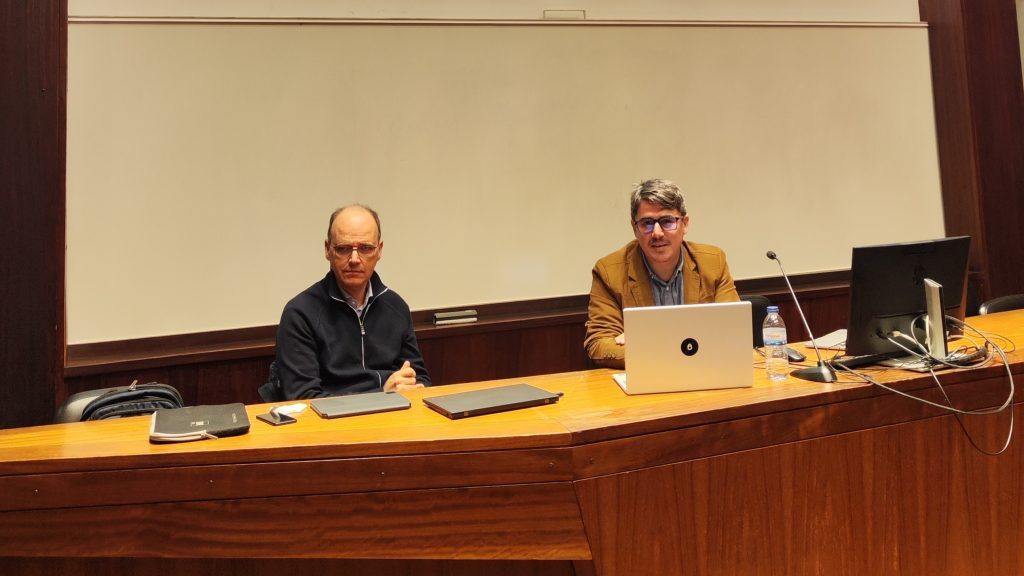
The conference centred on two presentations. Raimundo Elías Gómez, from the SSpaceGX project, presented Geospatial Footprints and Social Competences: Multi scalar Evidences, focusing on how geospatial data can be used to trace social interactions and competences across different territorial scales. Virgílio Borges Pereira, representing RURALITIC, followed with Implementing a social space approach to investigate rural Europe: a preliminary outline of the state of the art, which set out the conceptual foundations for analysing rural areas as relational social spaces.
A central moment was the presentation of a research roadmap intended to guide future studies of rural social space across Europe. The roadmap proposed an integrated approach that looks at social relationships, cultural meanings and physical environments together, rather than treating them as separate or isolated elements. This perspective responds to ongoing challenges in rural research, where fragmented methods can obscure how rural change is actually experienced and produced on the ground.
Empirical research presented during the session provided concrete illustrations of these ideas. Drawing on research conducted in the Gerês-Xurés World Biosphere Reserve, which spans the border between Portugal and Spain, researchers demonstrated the use of synchronous tools that combine spatial data with social analysis. These tools allow for a more precise examination of how social interactions unfold within specific physical settings, offering new possibilities for topological and relational research.
The discussion that followed highlighted both opportunities and constraints. Participants reflected on the difficulty of reconciling different research agendas, data sources, and methodological traditions when studying complex rural territories. At the same time, the exchange confirmed the value of small scale academic settings for testing ideas, refining concepts, and critically assessing ongoing work.
Why this matters for RURALITIC
For RURALITIC, organising events of this kind is an essential part of its research strategy. The conference reinforced the importance of methodological innovation and theoretical clarity at a time when rural areas are increasingly central to debates on sustainability, mobility, and territorial cohesion. It also underscored the role of academic collaboration in developing robust tools that can inform both scientific inquiry and policy discussion.
Looking ahead, the insights gained in Porto will feed into RURALITIC’s continuing analytical and comparative work, particularly its efforts to rethink how rural areas are defined and studied. The discussions helped refine rural concepts, supporting the project’s aim to move beyond narrow or purely statistical views of rural space.
For further RURALITIC updates or involvement in international events, follow us on BlueSky and LinkedIn. Our scientific publications are available on Zenodo.